
time is a flat circle is the second exhibition in a series of collaborations between Rip Space and bitforms gallery, bringing together work by Erick Antonio Benitez, Ricardo Cabret, Lou Fauroux, and Umber Majeed. The exhibition considers how contemporary mythology is constructed, circulated, and transformed across digital images, networked systems, and cultural exchange. At its core, the exhibition holds a condition of simultaneity: multiple histories, geographies, identities, and temporalities unfold in parallel. Within this overlap, myth functions as a framework for experiences that resist singular narratives. For those navigating diaspora and cross-cultural identity, the past is not left behind but remains active in the present — home exists in multiple places at once, symbols migrate, and inherited memory coexists with contemporary life.
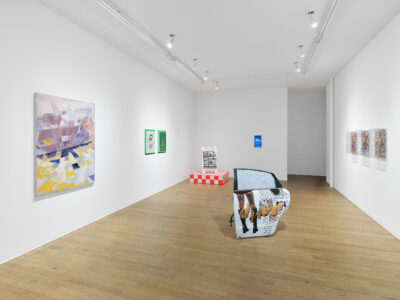
time is a flat circle is the second exhibition in a series of collaborations between Rip Space and bitforms gallery, co-curated by Vera Petukhova and Valerie Oakley. The exhibition brings together work by Erick Antonio Benitez, Ricardo Cabret, Lou Fauroux, and Umber Majeed in the consideration of how contemporary mythology is constructed, circulated, and transformed across digital images, networked systems, and cultural exchange. At its core, the exhibition holds a condition of simultaneity: multiple histories, geographies, identities, and temporalities unfold in parallel. Within this overlap, myth functions as a framework for experiences that resist singular narratives. For those navigating diaspora and cross-cultural identity, the past is not left behind but remains active in the present — home exists in multiple places at once, symbols migrate, and inherited memory coexists with contemporary life.
Extending this exploration of contemporary myth formation, Erick Antonio Benitez's work reimagines familiar cultural artifacts as carriers of collective meaning. In one series, a digital print layers Pokémon characters with Indigenous motifs and symbols drawn from contemporary culture. Suspended above the image, a vinyl-cut acrylic structure takes the form of the decorative gates commonly found on homes in El Salvador, where the artist's family is from. Functioning simultaneously as an architectural frame, and threshold, the overlay connects personal and collective histories while collapsing distinctions between ancestral and contemporary forms of storytelling. Together, these layered references suggest that myths are fluid structures through which ancestral symbols and digital forms of cultural memory circulate across generations and place.
Umber Majeed traces how history, technology, and identity are produced through visual systems, including state iconography, family records, and the aesthetics of Pakistani diaspora. The artist moves between the imagery of nuclear nationalism and the visual vernacular of South Asian kitsch, tracing how both are sustained through circulation and adaptation. The aesthetics of early internet culture connect inherited visual traditions with contemporary experiences of migration and displacement, creating hybrid mythologies shaped by both history and digital infrastructure.
Many exhibited works attend to the infrastructures that uphold contemporary image culture. In Ricardo Cabret's practice, fiber-optic cables, communication networks, software systems, and algorithms are visually represented as metaphors for the invisible structures that connect individuals across space and time. Drawing from Puerto Rico's telecommunications infrastructure and its complex geopolitical, ecological, and colonial realities, his work reveals the material networks that underpin contemporary experiences of connection and belonging.
About Rip Space: Rip Space is a curatorial platform based in Los Angeles dedicated to future-oriented creative practice and emergent art forms, often intersecting with digital art, new media, and technology. Founded by curator Vera Petukhova and run collaboratively with theorist, writer and educator Maisa Imamović and artist-technologist and producer Naomi Sam, Rip Space operates as both a platform for exhibitions and a site for critical inquiry through exhibitions, performances, screenings, workshops, talks, and community gatherings. The platform prioritizes process, experimentation, and collaborative ideation over fixed outcomes, creating space for artistic research and works in development. As the project evolves, Rip Space operates through a flexible and distributed model, working across physical and digital contexts while collaborating with artists, institutions, and independent spaces throughout Los Angeles.
Erick Antonio Benitez (b. Bronx, NY) is an interdisciplinary artist, curator, educator and musician based in Los Angeles & New York City. They received an MFA in Art + Integrated Media from the California Institute of the Arts in 2023 and a BFA in Painting from the Maryland Institute College of Art in 2014. Benitez has exhibited work at The Baltimore Museum of Art (MD), The Museum of Contemporary Art Arlington (VA), Connor Smith Gallery (DC), Dinner Gallery (NYC), Untitled Art Fair (Miami, FL), Galerie B-312 (Montreal, QC), La Fábrika (La Libertad, SV), SWAB Art Fair (Barcelona, ES), and Simultan Festival (Timișoara, RO). Their work has been reviewed by ARTnews, Architectural Digest España, BmoreArt, The American Scholar, The Daily Lazy, The Washington Post, Terremoto (MX), Mediana Magazine (SV), and Le Devoir (QC), and has appeared in printed publications including New American Paintings (Issue 154), BmoreArt (Issue 6), and Johns Hopkins: Special Collections. Benitez is the recipient of the inaugural Charles Gaines Fellowship Award, the Janet and Walter Sondheim Award, the Ruby Artist Project Grant in Performing and Media Arts, and the MASB Travel Artist Award, and has participated in residencies at The Studios at MASS MoCA (North Adams, MA), LFBK Residency (La Libertad, SV), and Pigment Sauvage “La Track” Residency (Montreal, QC, Canada). Benitez currently serves as full-time faculty at the Yale School of Art, as the inaugural AICAD Teaching Fellow.
Ricardo Cabret (b. 1985, Puerto Rico) uses painting and software to unravel the tensions between technology, landscape, and memory, navigating the political fantasy of a tropical paradise projected onto crumbling infrastructure through painterly processes of addition and subtraction rooted in abstraction. His layered works engage the tug-of-war between technological architectures—like underground fiber-optic cables and invisible transmission signals—and the looming threat of environmental collapse. Increasingly preoccupied with perception and how we inhabit a contested world, Cabret's new works depart from recollections of specific places and open onto universal questions of time and space.
He received his MS in Computer Science from the New York Institute of Technology in 2013, and a BS in Electrical Engineering from the University of Puerto Rico, Mayagüez in 2009. Past and upcoming exhibitions include Lo Invisible, Visible, La Salita, New York (2019); Tropical is Political, Museo de Arte Contemporáneo, Puerto Rico (2022); Un nuevo manglar, Michael Kohn Gallery, Los Angeles (2023); Un día, Efrain López Gallery, New York (2025); Transverse, Akiinoue, Tokyo (2026). His work is held in the permanent collections of the High Museum of Art, Atlanta and Museo de Arte Contemporáneo, Puerto Rico.
Lou Faroux (b. 1998, France) is a visual artist, filmmaker and DJ. In their films, sculptures and installations, they question the ethical challenges of artificial intelligence and virtual technologies, and their impacts on humans. They started producing moving images within a community of porn producers and actresses they met in Los Angeles. Describing themself as “a true product of bedroom culture’’, the images that inspire them are those of MTV’s pop ceremonies, YouTube music clips, American series pirated via MegaUpload, and conversations on Tumblr and Reddit. They reappropriate these images they grew up with, integrating their queer experience and building new mythologies around them. In doing so, the artist decrypts the entertainment and tech industries, their social structures of power and excesses. In their narrative, they reflect on the current and future uses of the Internet while speculating on their flaws and potential downfall. Fauroux immerses viewers in the vision of a world where we have failed to overcome the climate crisis, fascism, social inequalities, totalitarianism, technological innovations, and the regulation of stock markets. Their work presents a speculative take on the potential futures humanity could face, given current ethical and human dilemmas. It considers the unprecedented, exponential, rapid acceleration of technological innovations, its impacts, and the resulting anthropological changes.
Umber Majeed (b. 1989, New York) is a multidisciplinary visual artist and educator. She received her MFA from Parsons the New School for Design in 2016 and graduated from Beaconhouse National University in Lahore, Pakistan in 2013. Her writing, performance, and animation work engage with familial archives to explore Pakistani state, urban, and digital infrastructure through a feminist lens. Majeed’s solo exhibitions include; ‘In the Name of Hypersurface of the Present’, Rubber Factory, New York (2018) and ‘Trans-Pakistan Zindabad (Facts about the Earth)’, 1708 Gallery, Richmond, Virginia (2021), ‘Made in Trans-Pakistan’, Pioneer Works, Brooklyn, NY (2022), and J😊Y TECH, Queens Museum, NY (2025-6). She has shown internationally in group exhibitions at Hayy Jameel, Jeddah, Saudi Arabia (2024); the Asian Art Biennial at the National Taiwan Museum of Fine Arts, Taichung, Taiwan (2021); Ishara Art Foundation, Dubai, UAE (2019); the Karachi Biennale, Karachi, Pakistan (2017), among others. Majeed is a recipient of numerous fellowships including the HWP Fellowship, Ashkal Alwan, Beirut, Lebanon (2017), Refiguring Feminist Futures Web Residency, Akademie Schloss Solitude & ZKM, Germany (2018), the Digital Earth Fellowship, Hivos, the Netherlands (2018-19), Technology Residency, Pioneer Works, Brooklyn (2020), QM-Jerome Fellowship (2024), and ISCP Pollock-Krasner Fellowship (2025). Majeed is currently a Y12 NEW INC member- Extended Realities Track. Her work has been acquired by several private collections, including the Lekha and Anupam Poddar Collection at the Devi Art Foundation in Gurgaon, India.